


For many farmers contemplating transition, the core question remains: Is container-based Recirculating Aquaculture System (RAS) farming a capital-intensive endeavor or a pathway to high efficiency? Can it truly transform from a “heavy-asset investment” into a “high-efficiency operation”? Using high-value species like California bass (Micropterus salmoides) and the emerging species brittle snapper (Lutjanus vivanus) as examples, this analysis delineates the three critical accounts: capital investment, operational costs, and revenue potential.
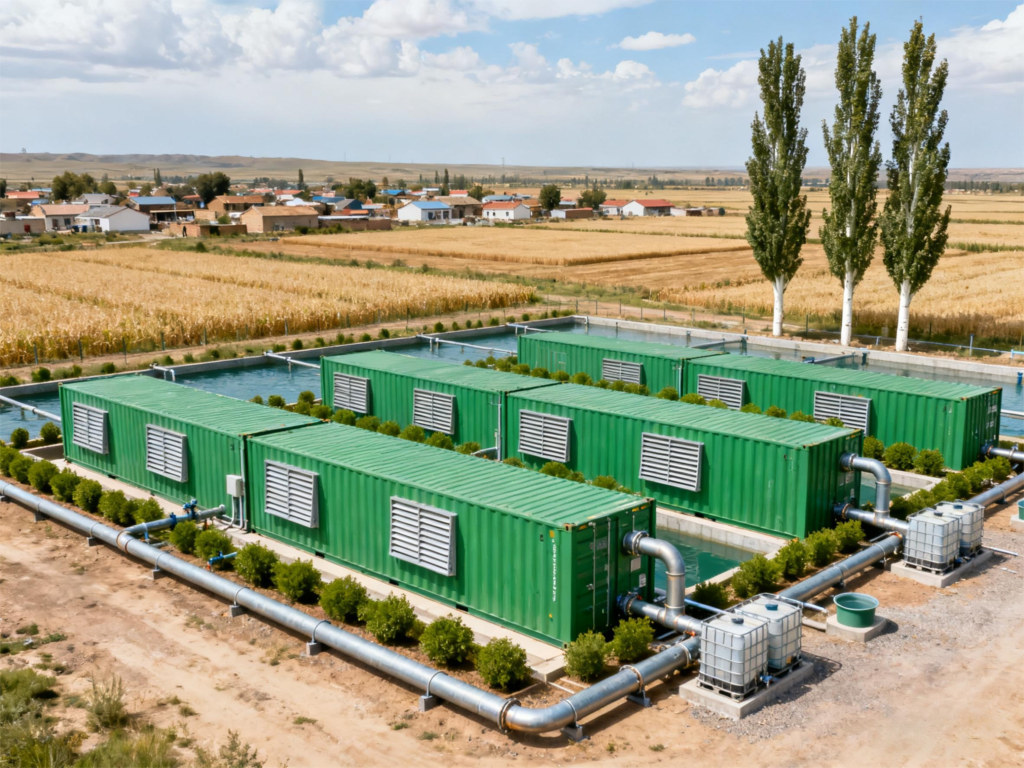
The Capital Investment Account: Modularity vs. Traditional Infrastructure
Traditional earthen pond aquaculture requires substantial upfront investment in land preparation, lease fees, and pond embankment construction, heavily dependent on specific geographical conditions. In contrast, the core advantage of container-based RAS lies in its “modular, turnkey” engineering.
The Investment Breakdown:
Initial Capital Outlay: A standard container aquaculture unit (equipped with a full RAS) functions as a “plug-and-play” production module. While its initial cost may exceed that of a single earthen pond, its Return on Investment (ROI) per unit of water volume productivity is significantly higher. Crucially, it requires minimal site preparation and can be rapidly deployed on vacant land or within existing buildings, eliminating extensive earthworks and associated costs and timelines.
Time-to-Production: The cycle from pond construction and water conditioning to stocking takes months for earthen ponds. A container system, however, can progress from installation and commissioning to stocking within weeks, dramatically accelerating capital turnover.
The Operational Account: Precision Management vs. Weather Dependency
Operational costs determine profitability. Traditional farming is vulnerable to weather and sudden water quality changes, leading to high disease risk and fluctuating costs for labor, utilities, and feed. Container-based RAS enables utmost control through a closed-loop system.
Key Operational Metrics Comparison (Based on an annual production target of 100 metric tons of fish):
| Operational Metric | Traditional Earthen Pond Aquaculture | Container-Based RAS Aquaculture | Comparative Advantage |
| Water Consumption | Very high, reliant on continuous water exchange | >95% water savings, core system relies on internal recirculation with minimal make-up water | Revolutionary water efficiency, resilient to drought and water restrictions. |
| Land Footprint | Requires tens of hectares | Requires only several hundred square meters (with compact layout) | >90% land savings, enables urban periphery or indoor farming. |
| Volumetric Productivity | California bass: ~1.5-2.25 MT/hectare | Brittle snapper: Annual yield can reach ~75 kg/m³; California bass productivity per unit water volume is 10-12 times that of earthen ponds. | Extremely high spatial efficiency. |
| Risk Management | High exposure to weather, external pollution, and disease outbreaks. | Fully controlled, isolated environment barriers external pathogens, reducing disease risk by >70%. | Highly stable and predictable production. |
| Labor Dependency | Labor-intensive: pond inspection, feeding, water quality management. | Highly automated, managed via central control systems, reducing labor by >50%. | Reduced management burden, lower labor cost and skill threshold. |
| Feed Conversion Ratio (FCR) | Fluctuates due to variable water quality and stress. | Consistently optimal water quality and minimal stress improve feed utilization, leading to a significantly lower FCR. | Direct reduction in the largest cost component (feed). |
The Revenue Account: High-Efficiency Output vs. Traditional Sales
The revenue account is the ultimate outcome of the previous two. The efficiency of container-based RAS translates directly into a triple premium capability:
High and Stable Yield Premium: As indicated, its volumetric productivity is multiple times higher than traditional methods, offering a decisive advantage in total output per unit area.
Off-Season Marketing Premium: Environmental control allows precise production scheduling for off-season harvests (e.g., during high-price periods like the Spring Festival), achieving selling prices 20-50% higher than in-season averages.
Quality and Brand Premium: Fish reared in clean, low-stress environments exhibit superior conformation, lack off-flavors, and have firmer flesh texture. They more easily qualify for green or organic certifications, accessing premium retail and foodservice channels, commanding higher prices, and building brand value.
Conclusion: Beyond the Balance Sheet, Leading the Future
The conclusion from these three accounts is clear: the initial investment in container-based RAS aquaculture is exchanged for long-term, stable, and high-efficiency returns. Its essence is replacing uncontrollable natural risks with manageable industrial capital.
This represents more than a technical upgrade; it embodies the convergence of the circular economy (water recirculation, near-zero effluent discharge), smart agriculture (IoT, data-driven decisions), and industrial revitalization (intensification, high value-added production). For enterprises seeking transformation, this is not merely about changing the pond but about adopting a new operational mindset for agriculture, positioning at the forefront of the future aquaculture industry.
 ES
ES  EN
EN  FR
FR