

Against the backdrop of consistently strong domestic demand for high-end Atlantic salmon, a land-based farming facility on Gaotang Island, Xiangshan, Ningbo, is quietly reshaping the industry landscape. Utilizing Recirculating Aquaculture System (RAS) technology, this project is not only a pioneering model for large-scale commercial operation in Asia but also serves as a crucial “testing ground” for the economic viability of land-based farming, with its ambitious target annual production of 20,000 metric tons.
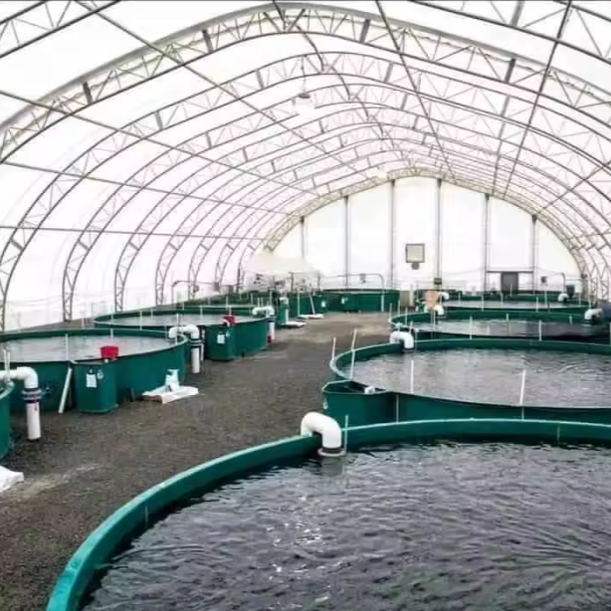
The core of this project lies in a highly intensive, controllable, and industrialized farming system. Its technical essence is first manifested in the advanced water treatment process. The system achieves a water reuse rate exceeding 99%. Through efficient biofiltration, precise degassing, and oxygen circulation control, it maintains water quality standards comparable to purified drinking water. Secondly, it involves the precise year-round simulation of the environment. A constant flow of chilled water within the facility perfectly replicates the native North Atlantic habitat of Atlantic salmon, enabling their “upstream growth” far from the ocean. Furthermore, the project has established a comprehensive biosecurity and quality control system spanning from source to table. This system encompasses everything from eggs sourced from Iceland with a 98% hatch rate to the operation of Zhejiang Province’s first designated isolation and quarantine facility for Atlantic salmon eggs.
However, advanced technology comes with significant costs. Substantial initial capital investment (in infrastructure and imported equipment) and ongoing energy consumption (for temperature control and water circulation) represent the primary challenges to its commercial scalability. To address this, the project has secured solid financial backing by introducing strategic investment from a Ningbo-based state-owned enterprise, transforming into a Sino-Norwegian joint venture. Concurrently, it is actively fostering a localized industrial ecosystem. For instance, it has deepened collaboration with the global feed leader Skretting to co-optimize specialized nutritional formulations for the RAS environment, aiming to enhance fish health and fillet quality and thereby extract value from details. Notably, the project has pioneered the first insurance product for land-based salmon farming in China. This insurance provides over RMB 200 million in risk coverage for risks inherent to high-density systems, such as water quality anomalies and equipment failures, exploring a financial solution for stable industry development.
Insight: The significance of the Ningbo project extends far beyond a single farming facility. It is a systematic experiment in the integration of capital, technology, and industrial ecology. Its success or failure will directly influence capital market confidence in the land-based RAS sector and provide a critical pathway for China to address dependencies in the sourcing of premium aquaculture stocks, controlled environments, and supply chains for high-end species.
 EN
EN  ES
ES  FR
FR