

Traditional aquaculture faces a triad of critical challenges: its dependence on natural conditions leaves it vulnerable to total loss from a single cold spell or disease outbreak; escalating constraints on land and water resources, coupled with stringent environmental regulations on effluent discharge; and extensive management practices that lead to low feed conversion ratios, eroding profits with high operational costs.
The Dual-Cycle System embedded in container-based Recirculating Aquaculture Systems (RAS) is designed precisely to overcome these hurdles. It creates a controlled, efficient, and closed-loop process through the precise synergy of an internal cycle for water conditioning and an external cycle for waste treatment and resource recovery.
The Internal Cycle – A “Constant-Temperature, Sterile ICU” for Fish
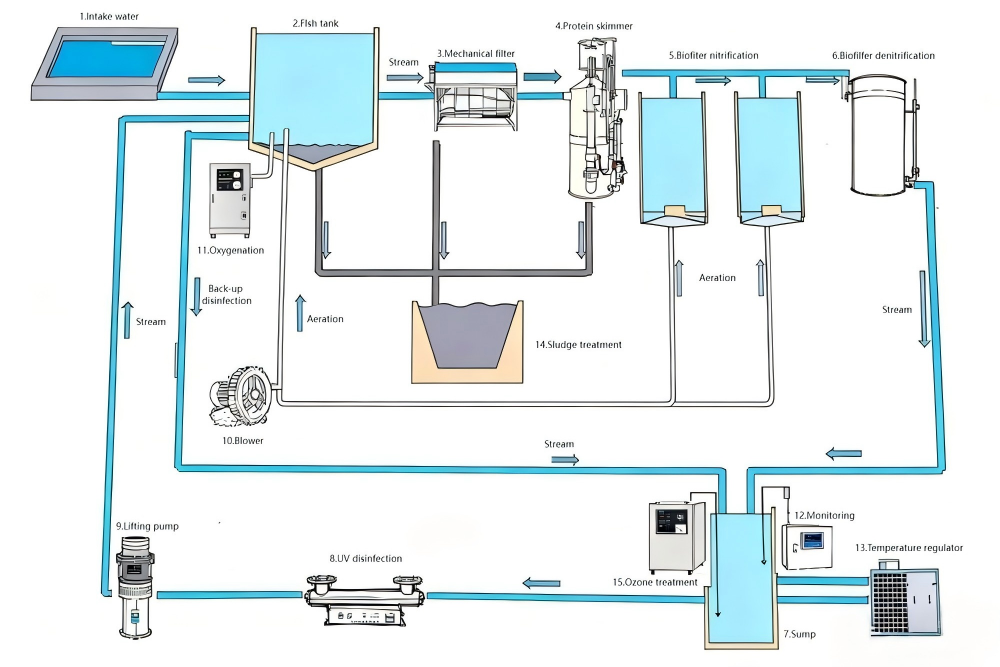
Within the container, water is not static but undergoes 24/7 purification in a loop:
Mechanical Filtration: Rapid removal of solid waste, such as feces and uneaten feed.
Biofiltration: The core process. Water passes through reactors filled with bio-media, where microbial communities (e.g., nitrifying bacteria) convert toxic ammonia and nitrite into less harmful nitrate.
Oxygenation and Temperature Control: Pure oxygen injection meets the high oxygen demand of dense stocks, and a thermoregulation system liberates production from seasonal constraints.
This process achieves effective fish farming with minimal water exchange, boasting a water reuse rate exceeding 95%. Key water quality parameters (e.g., dissolved oxygen, pH, ammonia) fluctuate less than one-tenth of the range typical in pond culture, providing an exceptionally stable environment that minimizes stress and fundamentally suppresses disease outbreaks.
The External Cycle – A “Resource Generator” for Waste Transformation
Concentrated wastewater and solid sludge separated from the internal cycle are not discharged but are treated in the external cycle for resource recovery:
Solid-Liquid Separation: Sludge is separated from the water stream.
Advanced Treatment: The liquid phase undergoes further purification via microbial degradation and/or plant absorption, allowing for reuse or compliant discharge.
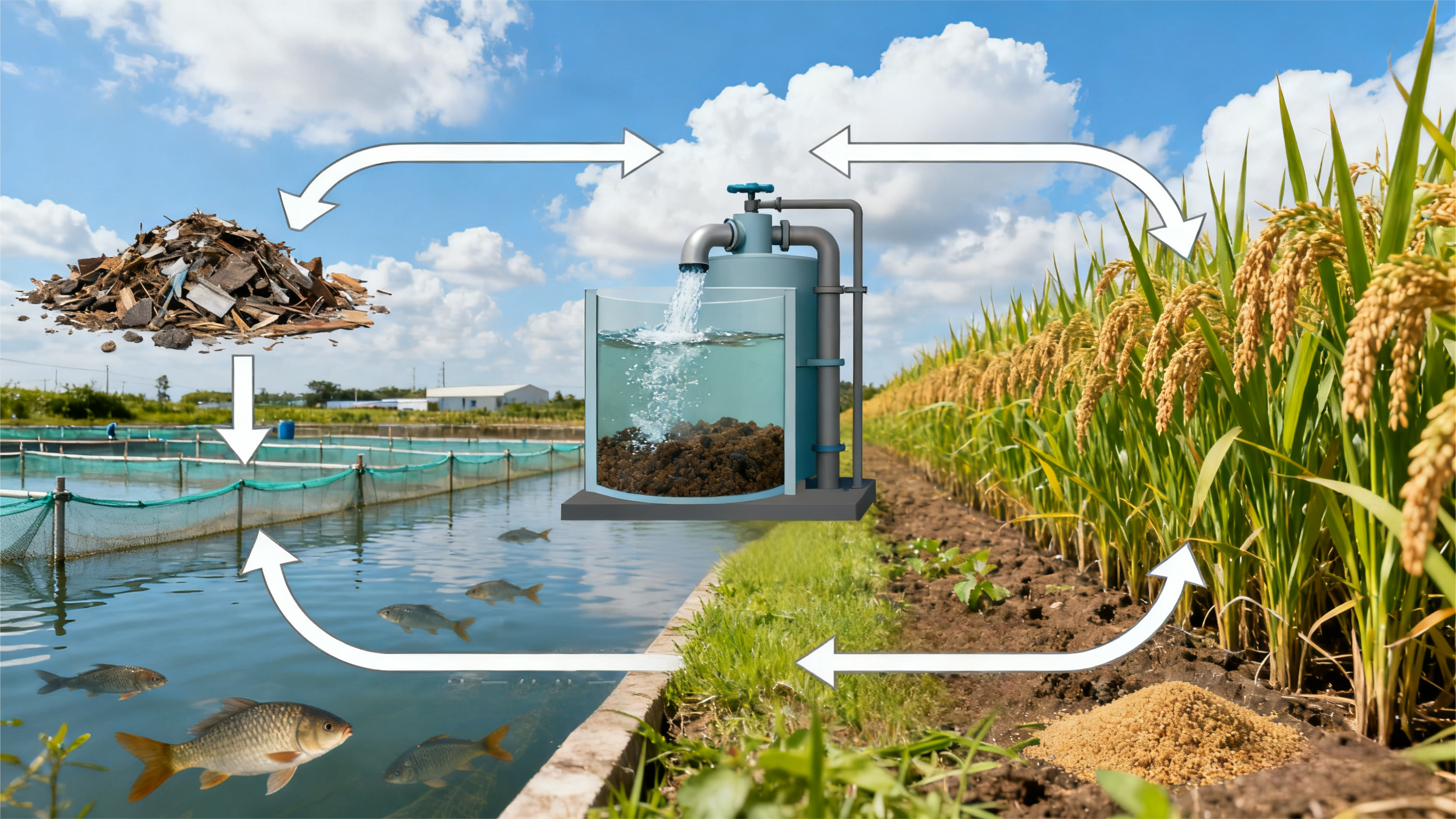
Resource Conversion: The separated solids, after stabilization and treatment, are transformed into high-quality organic fertilizer for agriculture or horticulture, enabling integrated systems like “aquaponics” and realizing a circular economy model.
Comparative Analysis: Traditional Pond Culture vs. Container-Based RAS “Dual-Cycle” System
| Aspect | Traditional Earthen Pond Culture | Container-Based RAS “Dual-Cycle” System | Core Differentiators & Advantages |
| Water Consumption | High dependency on continuous water exchange; annual consumption can reach 15,000-20,000 cubic meters per hectare. | Recirculation with make-up water <5% of total volume, saving over 95% of water. | Overcomes water scarcity limits, enabling operation in arid regions. |
| Land Use Efficiency | Requires approximately 100-150 square meters of pond area (including berms) to produce one ton of fish. | Produces one ton of fish using only 1-1.5 square meters of footprint (with vertical stacking). | Increases output per unit area more than tenfold, without using prime agricultural land. |
| Volumetric Productivity | Limited and unstable annual yield due to climate and seasonality. | Year-round controlled environment enables high density; for species like largemouth bass, productivity can reach 150 kg/cubic meter annually, 10-12 times that of ponds. | Enables intensive, off-season production. |
| Disease Risk | Open environment prone to pathogens; difficult to control, leading to high chemical use risk. | Closed system with purified water blocks pathogen entry; can reduce disease incidence by over 70%. | Ensures biosecurity and food safety, enhancing product quality. |
| Effluent Management | Concentrated discharge, difficult and costly to treat, creating major environmental pressure. | Internal treatment achieves near “zero liquid discharge”; solids converted to fertilizer create added value. | Turns a compliance cost into revenue, meeting strict environmental regulations. |
A “Turnkey” Solution: A Fast Track from Site Selection to Harvest
The essence of this system lies in its modularity and standardization. Each container is a fully integrated, pre-fabricated production unit. Upon delivery, only connection to utilities and brief commissioning are required, allowing operation to commence within weeks. This drastically lowers the technical barrier and construction timeline, enabling transitioning enterprises to seize market opportunities rapidly.
Profitability Focus: A Financial Model Using Largemouth Bass as an Example
Taking largemouth bass, a widely farmed species in Southern China, as an example, the “Dual-Cycle” system enables:
Stocking Density: Can reach 100-120 kg/cubic meter.
Growth Cycle: Temperature control allows year-round growth, shortening the production cycle to 6-8 months and enabling precise harvest timing for high-price periods like Chinese New Year.
Feed Conversion Ratio (FCR): Excellent water quality and reduced stress can lower FCR to 1.1-1.2, significantly better than the 1.5-1.8 typical in ponds.
The key profitability driver is “off-season + premium quality” supply. During winter, when pond fish are scarce, the system provides stable, high-quality live fish, often commanding a 30%-50% price premium over the peak-season price. Combined with savings on water, medication, and land, the overall economic benefit is substantial.
Leading a New Paradigm: From Production Unit to Strategic Asset
The container-based RAS “Dual-Cycle” system transcends mere farming technology. It is a perfect embodiment of the circular economy in aquaculture, transforming linear resource consumption into a closed-loop model. It represents the hardware realization of smart agriculture, enabling precision management through data. Furthermore, it serves as a powerful tool for rural revitalization, capable of efficiently developing high-value industries on unused land or near urban areas, offering a replicable model that attracts policy support and capital investment.
Choosing the “Dual-Cycle” system is not merely adopting a new technology; it is embracing a future-oriented, sustainable, and highly profitable new paradigm for aquaculture.
 EN
EN  ES
ES  FR
FR